
Where it can help
Support the work around the work.
Learning plans, career materials, meeting structures, content drafts, process maps, business operations, and other low-risk tasks can benefit from careful AI assistance.
Responsible AI
AI can help people learn, organize, draft, and improve a workflow. It should never blur who is accountable, what data is protected, or where human judgment must lead.
AI assists. People remain accountable.

Our position
Where it can help
Learning plans, career materials, meeting structures, content drafts, process maps, business operations, and other low-risk tasks can benefit from careful AI assistance.
What stays human
A generated answer is a draft to inspect—not a source of authority. The person or organization using it remains responsible for the data, decision, review, and outcome.
Five principles
These principles apply before a prompt is written, while output is reviewed, and after an AI-assisted workflow enters regular use.
Give the tool only what the task genuinely requires. Remove context that is merely convenient, especially sensitive or confidential detail.
Strip names and direct identifiers, then check whether the remaining combination of details could still identify a person.
Follow your school, employer, client, and legal requirements. A useful feature is not permission to use it.
Trace claims to reliable sources, test calculations and instructions, and treat confident language as unverified until checked.
Assign the person who reviews, decides, documents exceptions, and stops the workflow when the output is unsafe or unfit.
Safe-to-paste framework
A simple test cannot replace your organization’s policy, but it can stop an unsafe paste. Work through all five questions before information enters a general-purpose AI tool.
If the answer depends on an assumption, treat it as “not sure.”
Replace real names, dates, locations, IDs, and distinctive circumstances with neutral placeholders—or remove them entirely.
Check the current policy, account type, access controls, retention terms, and any required agreement.
Name the reviewer and the authoritative reference before generated content influences real work.
If the consequence is serious, redesign the workflow, use an approved specialist system, or keep AI out.
Proceed carefully
Use the minimum information, preserve the human review step, and stay inside policy.
Pause
Do not paste yet. Ask the policy, privacy, security, academic, or workflow owner.
Keep it out
Use a blank template, a fully synthetic example, or an approved system designed for the task.
Information examples
Every scenario below is synthetic and contains no real patient data.
Context still matters. “Generally suitable” means only after the tool, purpose, and reviewer have been approved; it is not automatic permission.
May be suitable after all checks
These inputs can support drafting or practice when they contain no restricted information and remain inside policy.
Keep out of general-purpose AI
Removing a name may not be enough. Rare events, exact dates, locations, or combined details can still point to a person.
Academic-use boundary
Your course, assessment, placement, publisher, and institution rules come first. If the permitted use is unclear, ask before using AI.
Keep
Do not
Organizational governance
A workflow is not governed because a policy document exists. The people running it need clear answers they can use during the work.
01 / Purpose + data
02 / Tool + access
03 / Review + action
04 / Record + improve
Direct-care disclaimer
NurseBuiltAI does not recommend using general-purpose AI as a replacement for clinical judgment, approved clinical systems, organizational policy, supervision, or direct patient-care decision-making.
Do not use this site, its resources, or a general-purpose AI tool to diagnose, triage, prescribe, calculate a dose, interpret patient-specific results, change treatment, determine escalation, or override a qualified professional.
When care is involved, use approved clinical systems and current authoritative guidance; follow local policy, scope of practice, supervision, documentation, and escalation procedures.
For an urgent or emergency care situation, use the appropriate local emergency and clinical escalation channels—not an AI prompt or this website.
Implementation guidance
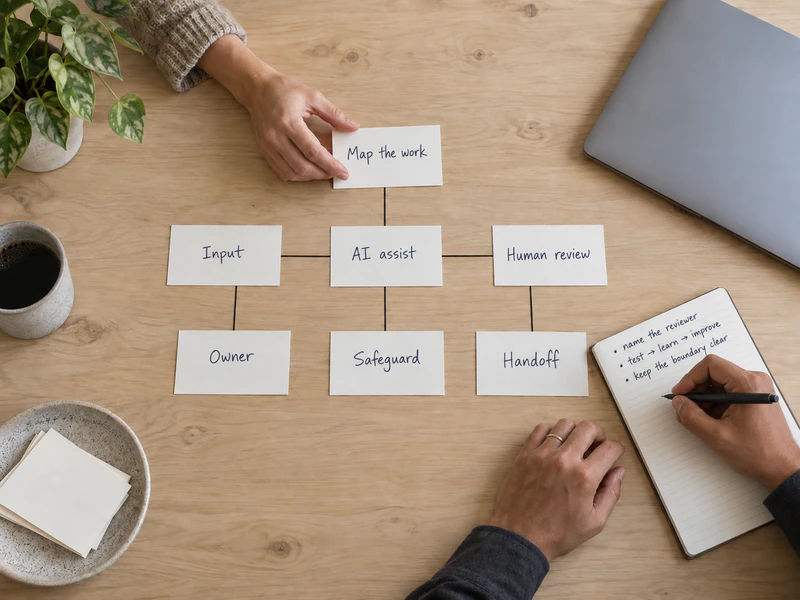
Map the task, data, tool, reviewer, safeguard, and handoff before asking a team to adopt AI.