AI systems. Human judgment.Practical AI for healthcare work and business.
For teams and organizations
AI implementation that starts with the work.
Move from scattered experiments to a defined workflow your team can understand, test, review, and improve—with clear ownership and responsible boundaries built in.
A practical fit for repeated work with a real owner.
We work with practices, schools, professional teams, associations, healthcare businesses, and founders who can name the work they want to improve—and the people who must stay responsible for it.
Good fit
You have a workflow worth understanding.
The strongest starting points are repeatable, reviewable, and tied to an operating need.
A team is repeating the same research, writing, planning, or administrative task.
Leaders want shared guidance instead of individual, untracked experimentation.
A process has a named owner who can participate in discovery and review.
The organization is prepared to define data, approval, and escalation boundaries.
Outside scope
The line stays clear.
NurseBuiltAI does not implement general-purpose AI as a substitute for clinical judgment, approved clinical systems, policy, supervision, or direct patient-care decisions.
No autonomous clinical decision-making or patient-specific recommendations.
No advice to place identifiable, confidential, or regulated data in unapproved tools.
No promise of legal, privacy, cybersecurity, or regulatory certification.
No tool purchase presented as a complete implementation plan.
Ways to work together
Choose the level of support the work needs.
An engagement can clarify one decision, train a team, shape a contained pilot, or support the path from discovery through handoff. Scope is agreed after the first conversation.
01 / Focus
Strategy Session
Frame the opportunity, pressure-test assumptions, and choose a sensible next decision.
Useful when: the question is defined but the route forward is not.
02 / Map
Workflow Discovery
Document the current work, inputs, friction, owners, approvals, data boundaries, and handoffs.
Useful when: people agree there is friction but describe the process differently.
03 / Learn
Staff Training
Build shared capability around approved use cases, prompting, verification, review, and escalation.
Useful when: a team needs common language and repeatable practice.
04 / Test
Pilot Build
Turn one bounded workflow into a testable system with specifications, reviewers, safeguards, and decision criteria.
Useful when: the organization is ready to learn through a contained test.
05 / Embed
Implementation Support
Support documentation, training, handoff, feedback, and improvement as a tested workflow moves into routine use.
Useful when: adoption and ownership matter as much as the initial build.
The method
Discover. Design. Pilot. Equip.
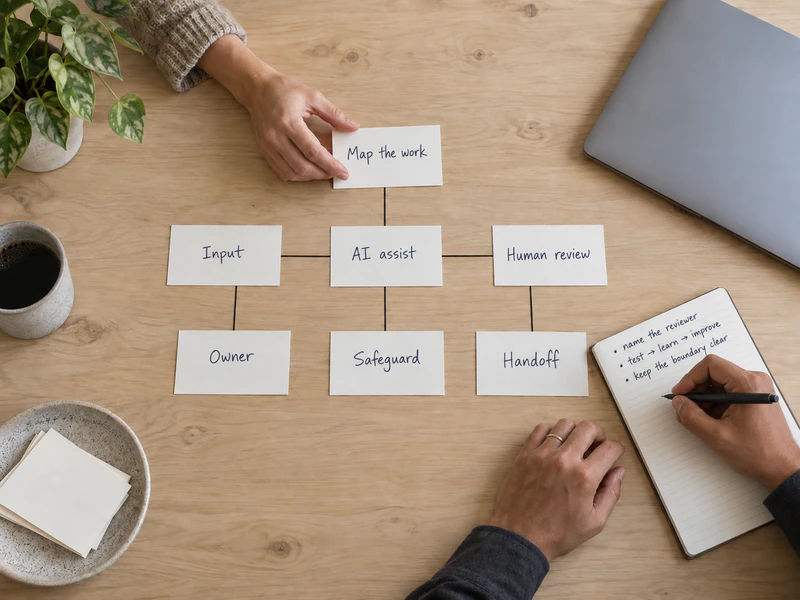
Each stage makes four things explicit: the output, the human owner, the safeguard, and the next decision. That keeps implementation connected to the work long after a workshop ends.
Tools enter the conversation only after the workflow, information boundaries, review responsibilities, and desired evidence are visible.
Stage 01
Discover
Output
Current-state workflow map and a focused opportunity brief.
Human owner
The person accountable for how the work operates today.
Safeguard
Identify sensitive inputs, approved environments, constraints, and non-negotiable review points.
Next decision
Is this workflow suitable and valuable enough to design?
Stage 02
Design
Output
Future-state flow, prompt or tool specification, roles, and test criteria.
Human owner
A workflow lead who can approve the proposed operating pattern.
Safeguard
Define what the system may assist with, what it must not do, and when people intervene.
Next decision
Is the design bounded, reviewable, and ready for a small pilot?
Stage 03
Pilot
Output
A contained pilot, observation log, and evidence for a go, revise, or stop decision.
Human owner
A pilot lead plus named reviewers for every consequential output.
Safeguard
Use approved test inputs, documented review, escalation routes, and clear stop conditions.
Next decision
Should the workflow stop, change, repeat, or move toward wider use?
Stage 04
Equip
Output
Working documentation, training materials, handoff, and an improvement cadence.
Human owner
The operational owner who maintains access, guidance, review, and updates.
Safeguard
Keep version history, feedback channels, review checks, and a route to retire the workflow.
Next decision
What will be monitored, by whom, and when will the workflow be reviewed?
Concrete outputs
Deliverables matched to the engagement.
Final scope depends on the workflow and organization. These are the working artifacts each engagement is designed to produce—not promises of operational or clinical outcomes.
Strategy Session
A decision you can act on
Decision brief
Prioritized opportunity shortlist
Initial risk and data-boundary notes
Recommended next-step sequence
Workflow Discovery
A shared view of the work
Current-state workflow map
Inputs, roles, approvals, and handoffs
Risk and data-boundary map
Readiness and opportunity brief
Staff Training
A repeatable learning system
Tailored training materials
Relevant practice scenarios
Verification and review checklist
Team guidance for responsible use
Pilot Build
A bounded test
Prompt and tool specification
Named review roles
Pilot plan and test criteria
Observation and decision log
Implementation Support
A maintainable handoff
Working documentation
Role-based training materials
Ownership and handoff plan
Feedback and improvement cadence
Responsible by design
Principles that shape every workflow.
Responsible implementation is not a disclaimer added after the build. It changes the inputs, permissions, review steps, documentation, and ownership from the start.
01
Minimize data
Use only what the task requires. Keep sensitive information out of the workflow wherever possible.
02
Use approved tools
Match the environment to organizational policy, permissions, privacy, and security requirements.
03
Verify outputs
Define how claims, sources, calculations, and generated material will be checked before use.
04
Name the reviewer
Assign a person to approve consequential work. “Human in the loop” becomes a real role, not a slogan.
05
Keep an exit
Document escalation, pause, revision, and retirement conditions before wider adoption.
Where to look
Use-case categories for discovery.
These categories are conversation starters. A use case is not suitable simply because AI can touch it; fit depends on the actual work, information, risk, owner, and review path.
Category 01
Internal knowledge
Organizing approved policies, procedures, notes, and source material so staff can locate and summarize information for review.
Category 02
Education operations
Drafting lesson structures, practice activities, facilitator notes, and internal training materials from verified sources.
Category 03
Business communications
Preparing first drafts, adapting approved messages, and creating reviewable communication workflows for teams.
Category 04
Meetings and projects
Structuring agendas, action logs, project briefs, status updates, and handoffs without exposing confidential material.
Category 05
Content systems
Turning an approved idea into a traceable research, drafting, review, reuse, and publishing process.
Category 06
Workforce and member support
Developing non-clinical career resources, onboarding materials, question libraries, and program communications.
!
Clinical boundary: these examples do not include diagnosis, treatment selection, triage, medication decisions, patient-specific recommendations, or replacement of approved clinical systems and professional judgment. Read the full Responsible AI framework.
Who is implementation support for?
It is designed for practices, schools, professional teams, associations, healthcare businesses, and founders working on education, operations, workforce, communication, or business workflows. Fit depends on the specific process and its responsible-use boundaries.
Do we need to choose an AI tool first?
No. Discovery starts with the work, users, inputs, decisions, and constraints. Tool requirements can then be evaluated against that picture and your organization’s approved environment.
Can the work involve patient or confidential information?
NurseBuiltAI does not advise placing identifiable, confidential, or regulated information into general-purpose tools. Any workflow involving sensitive data requires the organization’s own policy, privacy, security, legal, and governance review, plus an appropriately approved system.
Can we start with staff training?
Yes, when the training goal, audience, and approved boundaries are clear. If the team is still unsure which work matters, a strategy or discovery engagement may be the more useful first step.
What happens during the implementation call?
We discuss the repeated workflow, who owns it, who is affected, the information involved, current constraints, and what a useful first decision would look like. If there is a fit, the next step and scope can be defined from there.
Does NurseBuiltAI replace our clinical, legal, privacy, or security review?
No. The work can help make questions, roles, and boundaries visible, but it does not replace professional advice, organizational governance, vendor assessment, or required review by your authorized teams.
Start with the repeated work
Bring one workflow you want to understand better.
Share what the team repeats, who is involved, where the friction sits, and what a responsible first test might need to prove. You do not need a finished tool list or AI strategy.